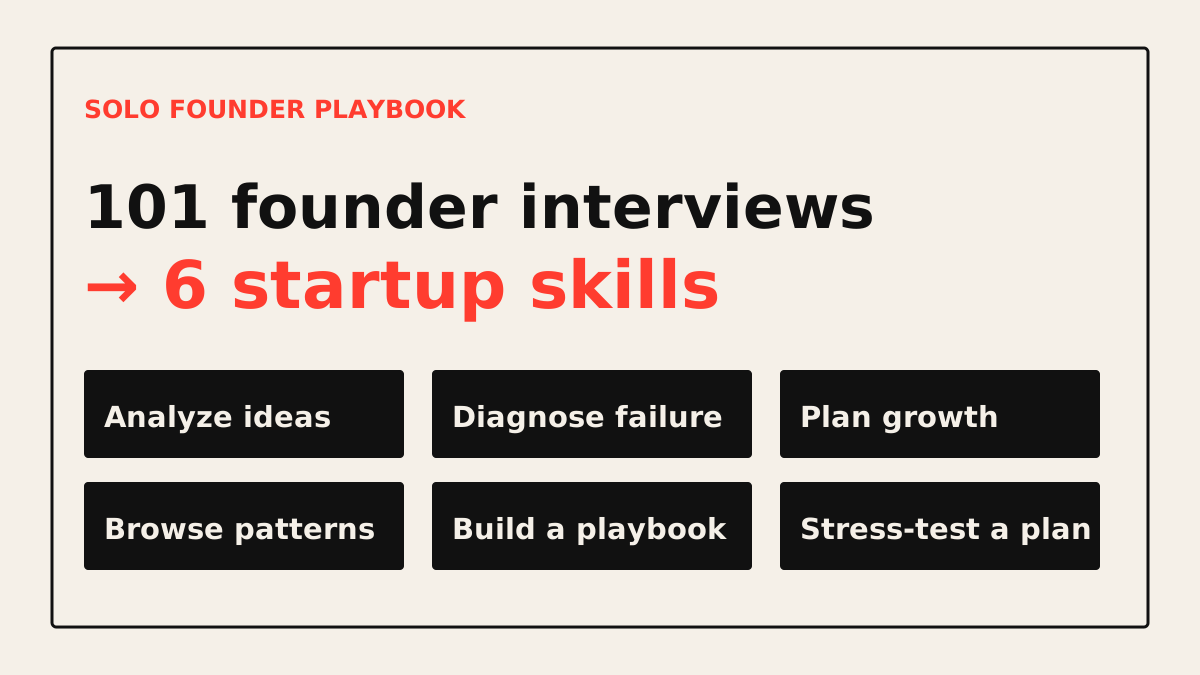
Startup advice from an AI assistant can sound convincing even when it has no source. Solo Founder Playbook takes a narrower approach: six skills for Claude Code and Codex, backed by a structured review of 101 Starter Story founder interviews.
What went into the toolkit?
The source material is long-form founder interviews. A five-step pipeline collected transcripts, grouped each interview into 11 startup topics, and extracted recurring patterns. The published knowledge base contains more than 80 patterns with frequency counts. A count means that a topic appeared in this set of interviews; it does not measure how often the strategy succeeds for all founders.
Choose the skill for the question you have
- /solo-analyze — compare a new idea with patterns for problem discovery and validation.
- /solo-failures — look for risks such as building without validation, cash pressure, or founder burnout.
- /solo-growth — explore distribution channels used by founders in the interview set.
- /solo-patterns — browse the underlying patterns by topic.
- /solo-playbook — turn a specific goal into a sequence of steps.
- /solo-roast — stress-test a plan with direct questions and evidence.
For example, instead of asking “How do I grow my startup?”, give /solo-growth your customer, price, current channel, and what you have already tried. The skill can then suggest experiments grounded in the dataset. The interview counts are a starting point for decisions, not a substitute for talking to your own customers.
Try it
Try the skills in your browser without installing anything. If you use Claude Code, the GitHub README has the plugin install commands. The same repository includes a Codex install script and all six skill files. The project is open source under MIT.
Want to see what the data says about failure specifically? Read seven failure modes from the interviews. To see how the data was assembled, read the pipeline walkthrough.