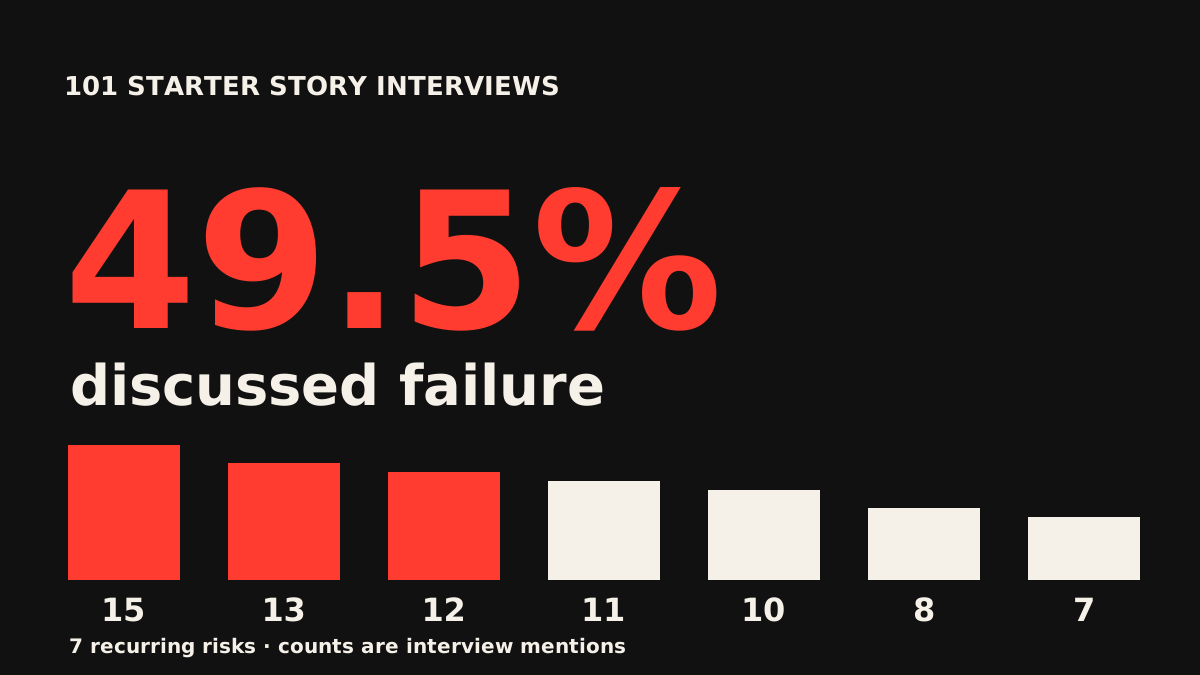
In a set of 101 Starter Story founder interviews, roughly half discussed failure openly. The interesting part is not a single dramatic collapse. It is how often familiar decisions appear before things go wrong.
The counts below come from the Solo Founder Playbook failure analysis. Categories can overlap, and these are interview mentions rather than population estimates or proof of causation.
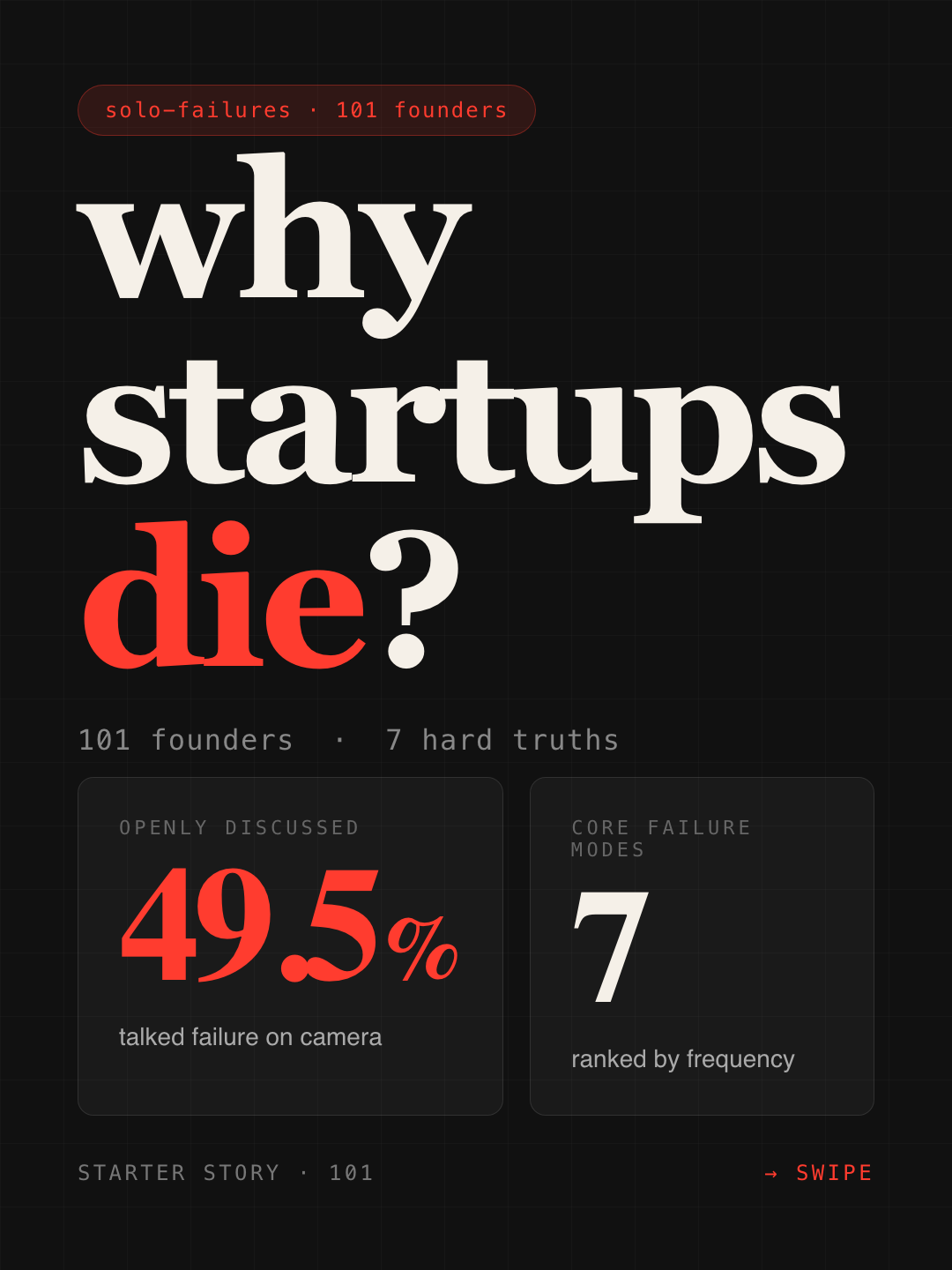
Multiple attempts before a breakthrough 15 / 101
A failed first venture can be information. The useful question is what changed between attempts: the customer, the problem, the distribution channel, or the founder's process?
Financial crisis 13 / 101
Running out of cash is often the final event in a longer chain. Work backward through demand validation, revenue, and spending before treating more funding as the whole solution.
Burnout and isolation 12 / 101
When one person makes every decision, fatigue changes the quality of those decisions. Put rest and a trusted peer review into the operating routine before the crisis.
Building without validation 11 / 101
Months of product work do not by themselves show demand. Ask what a customer has committed: time, a pilot, a pre-order, or payment.
Refusing to pivot 10 / 101
Attachment to an idea can make weak signals easy to explain away. Decide in advance what evidence would make you change the offer or audience.
No financial safety net 8 / 101
Personal cash pressure can force short-term choices. Model your runway and the revenue you need before making an irreversible commitment.
Repeatedly switching ideas 7 / 101
Changing direction can be correct, but restarting every few weeks prevents a channel or customer relationship from compounding. Set a review date and a measurable reason to stop.
Use the list as a diagnostic
Pick the two risks most relevant to your situation. Write down one observable signal for each and one action you can take this week. If you want a structured second opinion, try /solo-failures. The eight-card visual summary is also available.